

Learning German cases can feel confusing at first, yet it becomes clear once you understand how the system works. In German grammar, cases define how words function inside a sentence. They shape sentence structure and explain the relationship between subject and object. Instead of relying only on word order, German uses a precise case system to show meaning.
This approach may seem unusual for English speakers, but it actually makes communication more exact. As you explore each case, you will see how noun roles change naturally. With steady practice, these patterns begin to feel logical, helping you build confidence and improve your overall language skills with complete language learning hub guide.
The Nominative Case
When you begin learning German cases, you meet the nominative case first. It shows the subject (nominative) in a sentence. This means the person or thing doing the action. In German grammar, this is the base form. It helps you understand sentence structure and basic noun roles quickly.
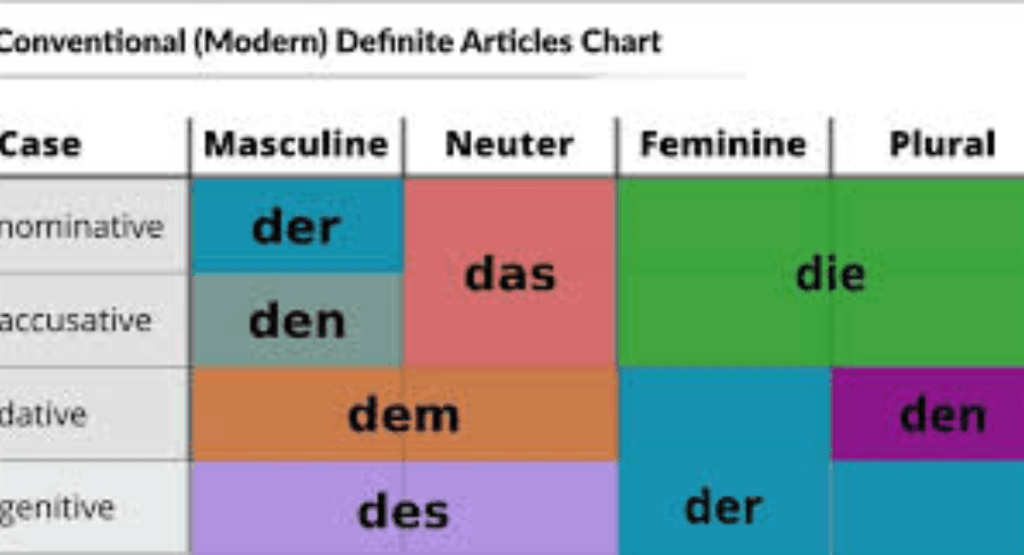
In simple terms, think of “The girl runs.” The girl is the subject. In German, this follows clear grammar rules and word order. You will also see German articles (der, die, das) here. These forms do not change yet. This makes early language learning easier and builds confidence.
The Accusative Case
Now things shift slightly. The accusative case shows the direct object (accusative). This means the thing receiving the action. In German cases explained, this is where learners first notice article changes, especially the masculine accusative change (der → den).
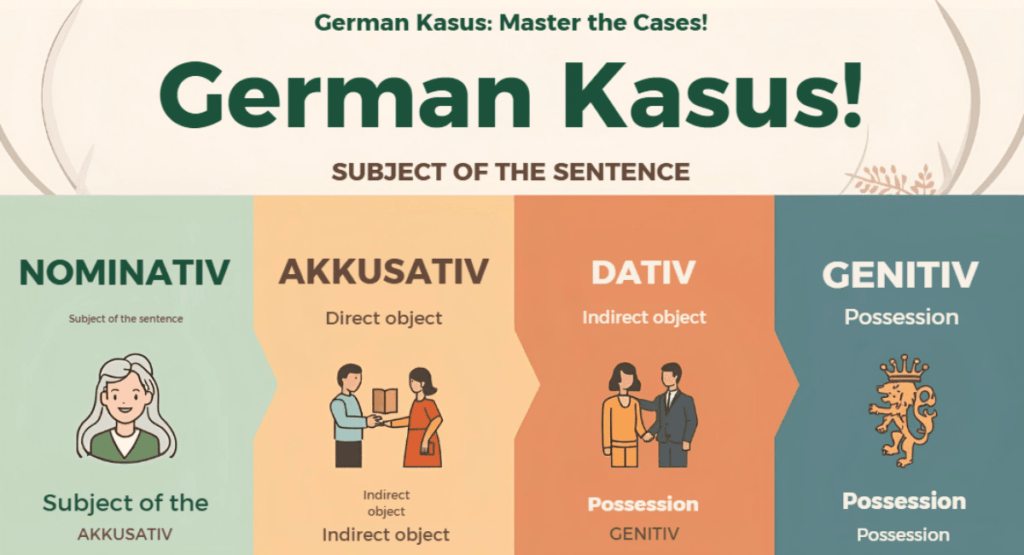
For example, “I see the dog” shows action moving toward something. This connects strongly to verb usage and the verb-case relationship. The sentence meaning becomes clearer when you ask case identification questions (who, what, to whom). This step deepens your understanding of sentence roles in German.
The Dative Case
The dative case introduces the indirect object (dative). It answers “to whom” or “for whom.” In real life, this appears in daily speech often. It strengthens your grasp of the case system and expands your ability to form meaningful sentences.
For example, “I give the boy a gift” shows a receiver. Here, the boy is the indirect object. You will use dative articles (dem, der, den) and notice changes in declension. This also affects adjective endings and overall linguistic structure, making communication more precise.
The Genitive Case
Ownership becomes clear with the genitive case. It expresses possession using the possessive form (genitive). In English, we say “the man’s car.” German uses endings like genitive endings (-s, -es) to show this relationship.
Although less common in speech, it remains important in formal writing. It helps refine your understanding of grammatical cases and deeper German grammar. This case also improves how you interpret complex sentences and understand advanced sentence meaning.
Prepositions and Case Usage
Prepositions guide cases in powerful ways. Many prepositions in German always require a specific case. For example, German prepositions (mit, für, von, durch) each control how nouns behave in a sentence.
Some are flexible. These are called two-way prepositions. They depend on motion or location. This affects word order and sentence structure. Understanding this part of German cases explained helps you avoid common mistakes and improves fluency faster.
Pronouns in Different Cases
Pronouns change shape across cases. This is essential in German cases. For example, German pronouns (ich, mich, mir) shift depending on their role. This reflects the subject and object clearly in conversation.
These changes connect closely with the case system and everyday speaking. They also show how sentence roles in German function naturally. Once you master this, your speech sounds more fluent and less robotic, which is key in real language learning.
How to Master German Cases
Mastering German cases explained requires practice and pattern recognition. Start by asking simple questions like case identification questions (who, what, to whom). This builds a natural instinct for choosing the correct case.
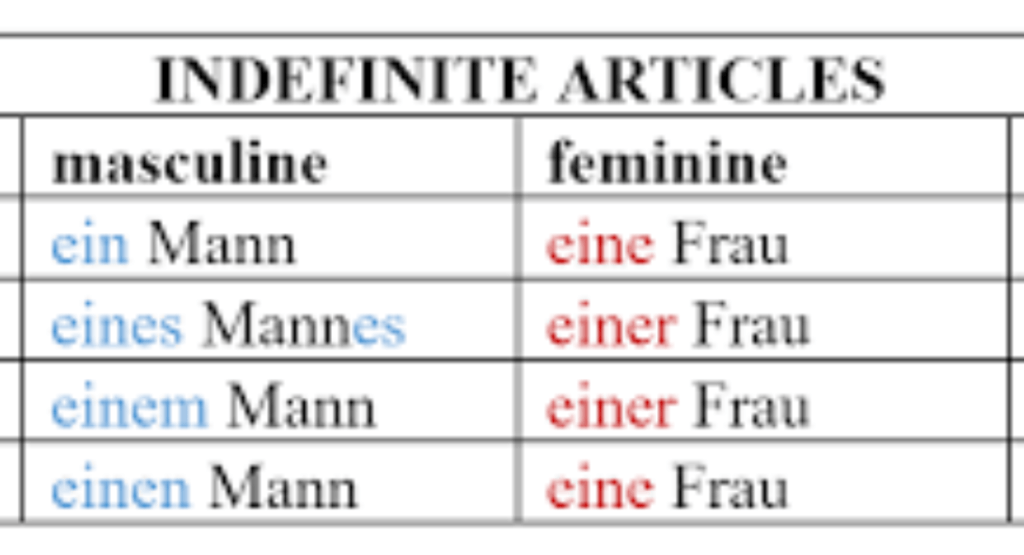
Next, focus on repetition and context. Pay attention to article changes, case endings, and verb-case relationship. Over time, your brain adapts to the patterns. This makes even complex German language basics feel manageable and intuitive.
Here is a simple reference table to guide you:
Case Role Question Example
Nominative Subject Who? The boy runs
Accusative Direct Object What? I see the boy
Dative Indirect Object To whom? I give the boy
Genitive Possession Whose? The boy’s book
Conclusion
Understanding German cases explained changes how you see the language. It is not random. It is a logical system built on clear linguistic structure. Each case adds meaning and clarity.
When you practice regularly, the patterns become natural. You stop memorizing and start understanding. That is the real goal of German grammar. Keep going, and soon you will use all four cases with ease.
FAQs
What is 777777 in German?
Siebenhundertsiebenundsiebzigtausendsiebenhundertsiebenundsiebzig.
What is the 80/20 rule in German?
Das 80/20-Prinzip (Pareto-Prinzip).
What are the 7 grammatical cases?
Nominative, accusative, dative, genitive, locative, instrumental, vocative.
Why does German have four cases?
To clearly show roles in a sentence without relying only on word order.
What is “I love you” in German to a woman?
Ich liebe dich.
Why is Katze feminine?
Because German assigns grammatical gender, and “Katze” is conventionally feminine.
How do I say “hi” in German?
Hallo or Hi.
Is ß still used?
Yes, ß (Eszett) is still used in standard German spelling.
Can I survive in Germany with only English?
Yes in cities, but basic German helps a lot.
How is Gestapo pronounced in German?
Geh-shtah-poh.
Why do Germans use H instead of B?
They don’t replace B; H often indicates vowel length or is part of spelling rules.
German cases explained Reddit?
Search: “German cases explained Reddit” for community tips and discussions.
German cases explained with examples?
Nominative (subject), accusative (direct object), dative (indirect), genitive (possession).
German cases table?
A chart showing der/die/das changes across four cases.
German cases explained for dummies?
Think: who (nominative), what (accusative), to whom (dative), whose (genitive).
German Cases Cheat sheet?
Quick reference of articles and endings for all four cases.
German cases table pdf?
Search online for “German cases table PDF” for downloadable charts.
German cases questions?
Who? (Nom), What? (Acc), To whom? (Dat), Whose? (Gen).
What are German cases?
They show the function of nouns in a sentence using endings and articles.
